Thursday, April 16, 2009

Adorno's dreams, indexed

While I was in Portland I found a book of Theodor Adorno's dreams. And the publisher was kind enough to index the major motifs. Imagine having an index to your own dreams--your own set of subconscious reference books.

Here's a snippet from Adorno's:

Serkin, Rudolf 61-2
sex: Babamüll technique 14-15, 96; in bed with L.'s wives 19-21; comments called out 50; cutlets playing a dog's game 50-1; and death 36, 101; prick washing machine 75; 'Verkehr' 96; vivdly dreamt 58; see also brothels; women
Shakespeare, William: The Comedy of Errors 25
shaving 29
Siegfried (mythological) 2
social manners and breaches: Kaiser Wilhelm and 24-5; at opera 9; ragged children and hoodlums 26; squeezing girls 50
sociology exam anxiety 57-8
Spann, Othmar 60-1
stars 35-6
Statue of Liberty 3
Steuermann, Eduard 41, 76
Stravinsky, Igor 46
Suhrkamp, Peter 73
sunglasses 11

Adorno seemed to hold a special fascination in his dreams with the architecture of brothels: one was devoted 80% to administrative staff, with only one dark room for the women. Another was located high in an American skyscraper, but resembled on the inside the sleeper car of a train--each woman in a different curtained vestibule.

He considered the dream journal a literary genre in its own right, and the afterword by Jan Phillip Reemstma attempts to explore it as such, especially in its dependence on non-meaning. And while this is true, one thing that struck me most about Adorno's dreams--and my own, in hindsight--is the almost voluptuous excess feeling of meaning you can feel in them--not so much in direct and readable information, which is sparse, but in the gut sense that something important has just passed--that a critical idea, or love, or connection has been made inside the dreaming mind, and has been lost on waking.

I don't believe that anything so critical actually does flash through our brains at night--rather, I think the parts of our minds that know how to make us feel as if we've just stood in the presence of the sublime feel it to be the only time they might trot outside, stretch their neurons. And we bask in the mystery of their calisthenics for the rest of the morning.

Tuesday, April 7, 2009

One Year Between Fiction Submissions

Just recently I sat down to send a story out to fiction magazines again. The last time I had mailed out--and it was the same piece I was mailing--seems to have occurred one year ago.

The process is surely painful, but if I don't face it more often, I'll continue at my present pace--virtually standstill. The excuses are good ones. Submitting work is better.

Thursday, February 12, 2009

Famous Outsider Artist Plays Rough-and-Tumble Accordion Ditty to Unappreciative Crowd of Lion King Attendees

So I'm walking home, nearing the Paramount Theater, and I hear a fellow pounding an accordion. Raspy voice, absurd quick staccato. Old guy. And I think to myself, "Huh, that's just like what I'd imagine Gregory Blackstock must have looked like, playing his accordion outside the Kingdome to raise money for trips to amusement parks--before he became a nationally acclaimed outsider artist." But it is Gregory Blackstock--singing a maddening number called "Beep Beep" and unnerving the children in their fancy theater coats.
And I'm stunned: the fellow has been fetishized as a artistic savant--I must admit my love for his work is in part due to my fascination with savants, his drawing sell for thousands of dollars now, he's got a fricken' book out... Even Comme des Motherfucking Garçons has used his illustrations in one of its collections--and he's singing and playing accordion outside the Paramount, and kinda scaring folks, and I just feel like I found the golden ticket in my Wonka bar because nobody else seems to understand why this is so great.

I think of saying something--"Hey guys, this is a very famous artist! Playing accordion! And frightening you!" Some guy asks him for directions, then overhears me as I beam a little too effusively over his drawings. The asker looked back, curious, confused, as I say this (for all appearances) mentally disabled accordion-busker, "I'm such a fan of your drawings! When are you showing again? I've purchased your book!" And part of this is the pleasure of secret knowledge and part of this is the idiocy inherent in systems of fame--because Blackstock is a fucking rock star. And he's playing his accordion for free. Outside of a theatrical production costing between $20 and $75 for admission, "not including fees." (Coming next month: Bob the Builder--Live!)

Nothing wrong with folks making a buck on spreading beauty around, but I'm continually struck by how much more beauty comes from the quiet and the sidelined and the unexposed. It seems that the more our tastes are culled and directed by mass-market forces, the more anemic they become.

Monday, January 12, 2009

Daniel Tammet, savant, on the absurdity of IQ

This hit me as so true:

The bell curve distribution for IQ scores tells us that two thirds of the world’s population have an IQ somewhere between 85 and 115. This means that some four and a half billion people around the globe share just 31 numerical values (“He’s a 94,” “You’re a 110,” ”I’m a 103”), equivalent to 150 million people worldwide sharing the same IQ score. This sounds a lot to me like astrology, which lumps everyone into one of twelve signs of the zodiac.

So much of the supposedly scientific work that went into quantifying the human animal in the 20th century had about it a vast assembly of voodoo and presumption. Numbers had in them a sense of magic, of "truth," just like photographs do--but the truths that each contain are so conditional, specific, and limited.

I hadn't heard of Daniel Tammet before, but his book looks to be worth reading--I must admit to holding a huge crush on autistic brains. The article in the link above had me kinda swooning.

Monday, December 1, 2008

Sunday, November 23, 2008

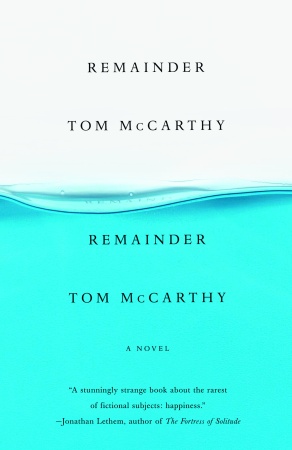
On Remainder by Tom McCarthy


For a few years I’ve been teaching “The Loss of the Creature” by Walker Percy--an essay ostensibly about the feeling of discovery, but also about sovereign control of one’s own perceptions, about willful sacrifice of that control, and about the evil of sacrificing the present moment to the domination of the past and the future.

The protagonist in McCarthy's novel is, to an extent, seeking a similar sovereignty. But he chases it through the reenactment: by returning obsessively, lovingly, completely, to the single mysterious moments in which he felt clarity. Staging them, rebuilding them, recreating them--and in this complete simulacrum, he feels closer than he ever has to being real.

On the surface it’s an easy reversal: nothing feels real except for the staged. But beneath is what can only be described as insight--for as the game continues, I agree with the narrator’s discoveries, even as the implications of them become more sinister. I feel their logic. And at the end of the novel--when the narrator is quite happy, in fact, and no one else has any good reason to be--I feel doubly possessed, haunted, by that conflation.

What I’m trying to say is that, when I finished Remainder, I didn’t talk for a while. I felt that some trauma had been done to my cherished neural paths, and I needed some time inside of that trauma. It took a while to remember: it is a Sunday. I am at the window of my livingroom. I am looking over a courtyard. It is Fall. I came slowly back into myself--and I’m hardpressed to remember a book that had so thoroughly rewired me.

I should give some warnings: this machine takes a while to get to full speed. At or around page 80, I took a peek deeper in to reassure myself that the rest of the trip would be worth it. For the most part I speed-read the first 150 pages. Then, the patterns started looping back. And like some chant, I fell into its rhythms.

Other things I can’t stop thinking about: Buddhism (of course). But everything makes me think of Buddhism right now. Boys of Life by Paul Russell. Jean Baudrillard, Slavoj Zizek, Guy Debord, all the glorious complicators of the real. Autism, art, autistic art, and the smell of cordite. And--really--the lingering question: what is the relationship between discovery and destruction? Finding and feeling and fucking over? It's beautiful, terrifying, to grasp: it's like Zeus's revelation of his divine form to Semele--the glory of it consumed her, burnt her up. But I think that, to a certain extent, that consummation by fire is just where we should push toward.

Long story short: McCarthy's novel, then, is about happy endings.